The End of Snail-Mail: The IRS Wants to End 30-Day Delays
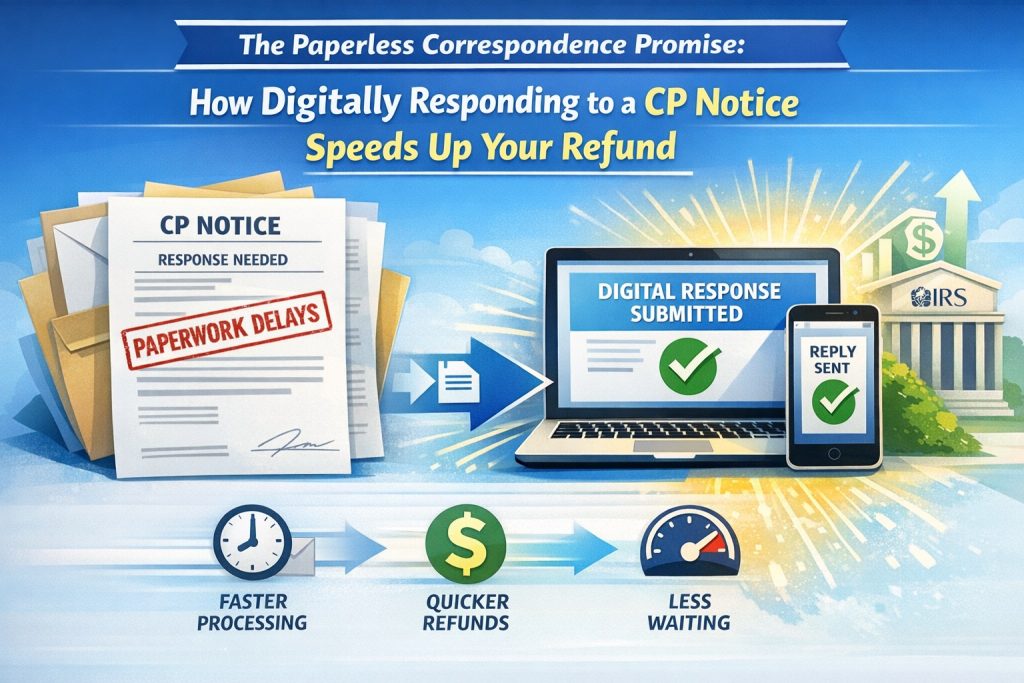
For decades, the IRS processed notices the old-fashioned way:
A letter was mailed to you
You mailed documents back
The IRS received them
They logged them manually
Your refund finally resumed
That process often took 3–6 weeks of dead time, not counting internal processing delays.
Now in 2026, the IRS has shifted toward a new model:
Digital notices and digital document submission.
And for taxpayers waiting on a refund release — this is a game changer.
Why Digital Submission Speeds Up Refund Processing
When you receive a CP notice (like CP05, CP75, CP12, etc.), responding digitally:
- Skips the USPS delivery delay
- Avoids mailroom sorting
- Eliminates manual scanning of paper
- Allows instant connection to your IRS file
- Sends your documents into verification processing immediately
This alone can accelerate your refund release by 15–30 days.
Which Notices Can You Respond to Digitally?
The IRS is rapidly expanding digital response capability. Currently, you can submit documents online for notices such as:
- CP05 — Income/withholding verification
- CP11 — Math error adjustment
- CP12 — Changes in refund amount
- CP75 — EITC documentation request
- 5071C — Identity verification
- CP2000 — Unreported income
And many others will follow.
If your notice says “You may respond electronically” — take that option immediately.
How To Digitally Respond Step-By-Step
Here’s the step-by-step procedure for submitting your response electronically:
1. Log into your IRS Online Account
irs.gov/account
This is your digital IRS profile.
2. Locate the notice
Under:
Notices & Letters
You will see the exact notice that triggered your refund hold.
3. Upload documentation
You can submit:
- W-2 copies
- 1099s
- Proof of income
- Dependent dispute proof
- Residence documentation
- Identity documents
Accepted formats:
PDF, PNG, JPG, JPEG
4. Receive digital confirmation
The IRS acknowledges receipt immediately — no waiting 5–10 days for the mail to arrive.
5. IRS review begins immediately
Your digital documents move directly into your IRS processing file.
6. Refund hold is lifted
Once the IRS verification completes, you will typically see:
TC 571 — Reverse of TC 570
followed by
TC 846 — Refund Issued
Biggest Advantage: No More “Lost Documents”
With paper mail, documents could:
- Be lost
- Be mis-sorted
- Arrive late
- Arrive incomplete
- Be detached from your file
- Sit waiting for manual scanning
With digital submissions:
Nothing gets misplaced.
Nothing gets separated.
Nothing gets lost.
Your tax file and your documents are linked instantly.
A Critical Tip: Respond Quickly
If a CP05 requests documents and you upload them the same day:
You can cut weeks off your refund timeline.
If you mail them…
You wait:
- 5–10 days for delivery
- 5–9 days for check-in
- 7–14 days for scanning and assignment
That is 3–4 weeks of avoidable delay.
Proof on Your Transcript
After responding digitally, you may see:
TC 971 — Notice issued or received with reference
followed by:
TC 570 — Refund Hold
and finally:
TC 571 — Freeze lifted
Translation:
The IRS has verified your data and cleared the review.
The Paperless Future of IRS Correspondence
The IRS has publicly stated that the goal for 2026 is:
80% of all notices will be eligible for digital response.
And soon:
Every notice — including identity confirmations — will be fully digital.
No printing.
No mailing.
No waiting.
Who Benefits Most
This digital option especially benefits:
- EITC/ACTC claimants
- Taxpayers with income verification holds
- Return discrepancies
- Wage matching delays
- Identity verification
- Dependent qualification reviews
In the past, these situations caused months of delay.
Now many can be resolved in days.
If the IRS gives you the option to respond online — ALWAYS use it.
Digital responses:
✓ Arrive instantly
✓ Are never lost
✓ Begin review immediately
✓ Can release refunds weeks sooner
Paper mail is now the slowest, worst option — and will eventually disappear entirely.
