What a “Blank” Tax Transcript Really Means
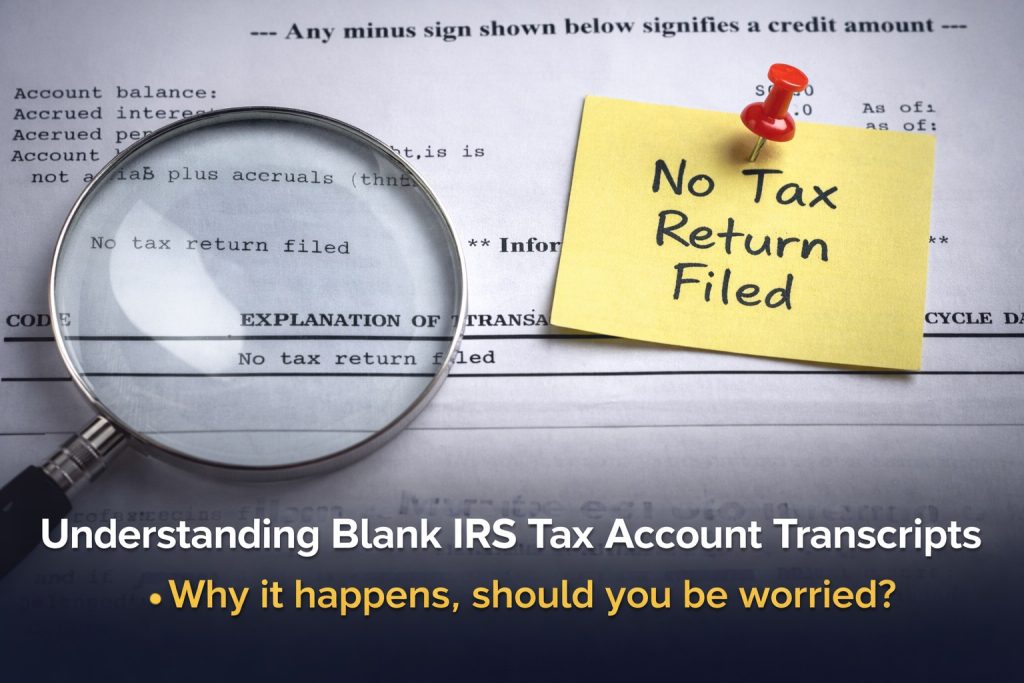
Every filing season, thousands of taxpayers log into their IRS Online Account expecting to see refund movement — and instead find what looks like a blank tax account transcript.
No return information.
No refund code.
Sometimes even a line that says:
“No tax return filed.”
Let’s break down what this actually means from a procedural IRS processing standpoint.
First: What Is an IRS Account Transcript?
An Account Transcript reflects activity posted to your IRS master file account. It includes:
- Transaction codes (TC 150, 570, 846, etc.)
- Processing cycle information
- Adjustments
- Refund issuance data
- Accrued penalties or interest (if applicable)
It is not a copy of your tax return — it is a record of IRS account activity.
What Does a Blank Account Transcript Mean?
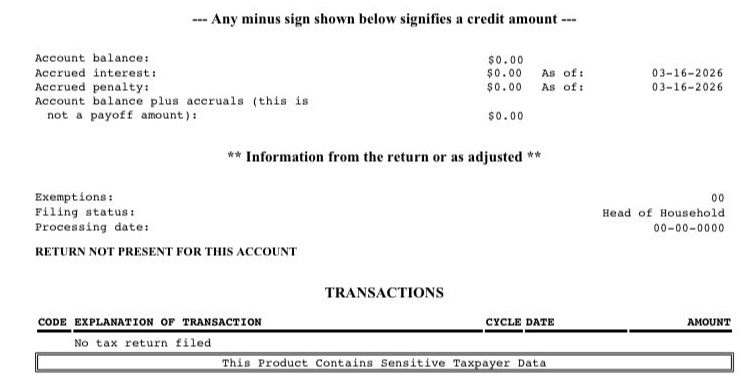
A “blank” transcript generally means:
The IRS Has Not Yet Posted Your Return to the Master File
Under normal IRS processing procedures:
- Returns are received
- They go through validation and error resolution
- Once accepted and systemically processed, a TC 150 (Return Filed) posts
- That posting generates transcript data
If TC 150 has not posted yet, the account transcript will appear blank or show:
“No tax return filed”
This does NOT automatically mean:
- Your return was rejected
- Your refund was denied
- Something is wrong
It usually means your return is still in pre-posting stages.
Common Reasons for Blank Transcripts
Early in the Filing Season
If you filed very early, especially before major weekly processing cycles, your transcript may not populate until the first batch posts.
PATH Act Timing (EITC / ACTC Filers)
Under IRC §32 and related refund hold rules:
- Refunds involving EITC or ACTC are held until mid-February.
- Transcripts may remain blank until after the hold lifts and the return posts.
Weekly Cycle Accounts
Most individual accounts update weekly (Thursday/Friday cycles).
If you check before your cycle updates, you’ll often see no movement.
Returns Still in Error Resolution
If the IRS flagged:
- Income mismatches
- Identity verification triggers
- Credit discrepancies
The return may sit in internal processing before posting — meaning no TC 150 yet.
Identity Verification Required
If an identity verification letter (such as a 5071C or 4883C) was issued, transcripts often remain blank until verification is completed and the return resumes processing.
What Should You See Once It Updates?
When the IRS posts your return, you’ll typically see:
- TC 150 – Return Filed
- Credit codes (e.g., withholding, refundable credits)
- Eventually TC 846 – Refund Issued (if applicable)
That is the moment your account transcript transitions from “blank” to active.
How Long Should You Wait?
Under normal IRS guidance:
- E-filed returns: 21 days is the standard processing timeframe.
- Paper returns: Can take significantly longer.
- Identity verification cases: May add 2–9+ weeks after completion.
If you are:
- Within 21 days of e-filing
- Not showing IRS notices
- Seeing “Return Received” on Where’s My Refund
A blank transcript alone is not cause for alarm.
When Should You Be Concerned?
You should investigate further if:
- It has been more than 21 days (e-file) with no movement.
- Where’s My Refund shows “still being processed” beyond normal cycles.
- You received an IRS letter.
- Your refund amount disappeared from WMR.
- You see a delayed refund message referencing review.
At that point, transcript analysis becomes more technical.
Important Clarification: “No Tax Return Filed” Does NOT Mean They Didn’t Get It
This is one of the biggest misconceptions.
That message simply means:
The return has not yet posted to the Individual Master File.
It does not confirm acceptance status.
It does not confirm rejection.
It does not confirm audit.
It confirms only one thing: no TC 150 has posted yet.
Strategic Advice for Taxpayers
✔ Check transcripts once per weekly cycle (not hourly).
✔ Watch for Friday updates.
✔ Monitor IRS notices in your online account.
✔ Avoid calling the IRS before 21 days unless directed.
Excessive checking does not accelerate processing — but understanding the codes does reduce stress.
Final Thoughts
A blank tax account transcript is typically a timing issue — not a problem.
The IRS processes returns in systemic batches, not real-time updates.
Until your return posts, your transcript remains empty.
If you’re seeing a blank transcript right now, you are most likely in the waiting phase — not the problem phase.
