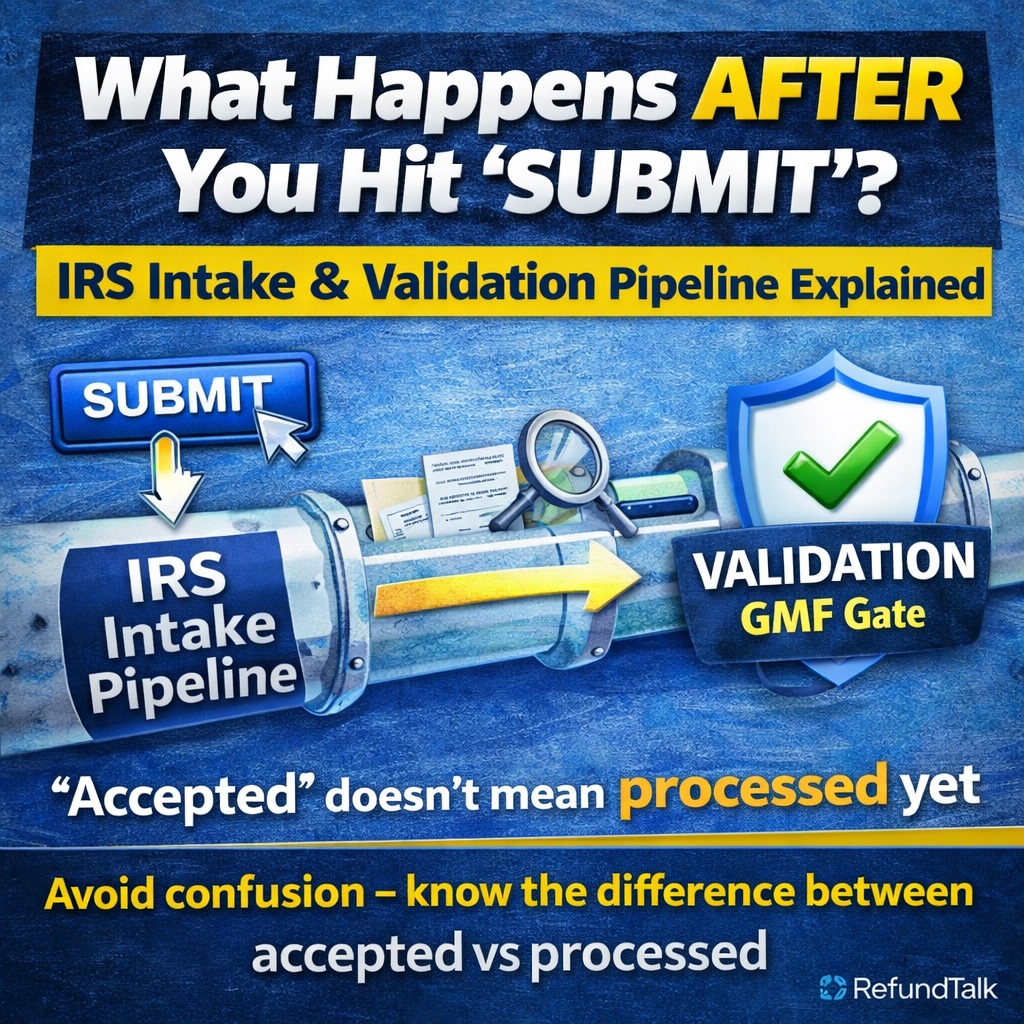
What Happens in the Seconds After You Hit “Submit”
When taxpayers click “Submit” on an e-filed return, many assume the IRS immediately begins calculating their refund. In reality, the return first enters a high-speed intake and validation pipeline designed to screen millions of submissions for basic digital integrity before human or systemic tax processing ever begins.
The very first checkpoint in that pipeline is the GMF Validation Gate.
Understanding this phase is critical, because one of the most common taxpayer misconceptions is believing that “Accepted” means “Processed.” It does not.
The GMF Validation Gate: Why “Accepted” Doesn’t Mean “Processed”
What Is the IRS GMF Validation Process?
The Generalized Mainline Framework (GMF) is the IRS’s front-end validation system for electronically filed tax returns. Its sole purpose is to confirm that a return meets minimum electronic filing standards before it is allowed to proceed deeper into IRS systems.
At this stage, the IRS is not evaluating:
- Refund amounts
- Credits (EITC, CTC, ACTC, etc.)
- Identity verification
- Audit risk
- Processing cycles
GMF is strictly a structural and formatting gate.
Think of GMF as the IRS equivalent of a digital quality control scanner.
What GMF Checks (And What It Does Not)
GMF Does Validate:
- Valid Social Security Numbers and ITIN formats
- Proper taxpayer and spouse name fields
- Correct filing status codes
- Required schedules and forms included
- Valid electronic signatures (PINs)
- Schema compliance with IRS e-file specifications
GMF Does Not Validate:
- Income accuracy
- Withholding amounts
- Credit eligibility
- Refund legitimacy
- Fraud indicators
- Transcript posting or refund timing
Passing GMF simply means the return is digitally acceptable, not substantively reviewed.
Why “Accepted” Is Only a Receipt — Not a Processing Milestone
When your tax software displays “Accepted,” it is confirming only one thing:
The IRS GMF system successfully received and validated the return’s electronic structure.
At this moment:
- The return has not posted to the Master File
- No IRS transcript exists yet for the filing year
- No processing cycle (daily or weekly) has been assigned
- Where’s My Refund may still show no record
This is why many taxpayers see:
- “Return accepted” but no transcript updates
- “No record of return” messages early on
- N/A placeholders for the current tax year
All of that is normal immediately after GMF acceptance.
What Happens If GMF Finds a Problem?
If GMF detects a structural issue, the return is rejected immediately and never enters the IRS processing stream.
Common Outcomes:
- The IRS issues a Reject Code (often R-series, such as R0000)
- The return is sent back to your tax software
- No IRS account is created for that submission
- Nothing posts to transcripts
The taxpayer or preparer must correct the error and re-submit the return, restarting the pipeline from the beginning.
What Happens After GMF Acceptance?
Once a return passes GMF, it moves into the next internal phase:
Transcription & Staging
- The return is converted into IRS-readable records
- Data is staged for the appropriate Master File (IMF)
- Processing controls are applied
- The return awaits batch assignment
Only after this stage does the return enter:
- Daily or weekly processing cycles
- Transcript posting schedules
- PATH Act filtering
- Identity and fraud screening
In other words, GMF acceptance is the doorway — not the journey.
Why This Phase Matters for Refund Expectations
Misunderstanding GMF leads to:
- Premature refund expectations
- Confusion when WMR does not update
- Panic over missing transcripts
- Incorrect assumptions about delays
For taxpayers tracking refunds closely, especially those relying on IRS transcripts, understanding the GMF Validation Process explains why there is often a quiet gap between acceptance and visible progress.
“Accepted” means your return passed the IRS’s digital front door.
It does not mean:
- Processing has started
- Refund timing has been determined
- Credits have been approved
- A transcript exists yet
Those steps come after GMF — inside the IRS processing engine.
